



For years, mainframe operations were built around a simple premise: daytime was for processing, nighttime was for consolidation. The batch window was when systems closed transactions, reconciled data, and reorganized workloads. That model worked—until transaction volumes stopped following the clock.
Today, with Pix, Open Finance, and applications available 24/7, processing never slows down. It keeps growing while the batch window continues to shrink.
The result is not merely technical. It is operational and financial: batch jobs competing with real-time transactions for resources, higher R4HA values, and direct pressure on MIPS costs.
The problem is not only the volume. It is the way that volume arrives.
In 2024, Pix surpassed 63 billion transactions, with peak days such as Black Friday concentrating nearly 240 million transactions in a single day.
This growth has not been accompanied by a reorganization of execution models. Instead, overnight processing now competes with a continuous workload that never stops.
Operations teams know the consequences all too well:
- Compressed batch windows
- Jobs piling up and delaying dependent processes
- Dataset contention and Db2 locking
- Jobs starting on schedule but finishing too late
In this scenario, insisting on yesterday’s operating model means trying to fit continuous workloads into a time window that no longer exists. There is a comfortable assumption that this pressure comes entirely from increasing demand. It doesn’t.
A significant portion of the problem lies in the way applications have been built and evolved over the years:
- Inefficient Db2 queries
- Redundant COBOL loops
- Chatty APIs generating unnecessary calls
- Processes that have never been revisited
At scale, milliseconds become hours, and hours become costs. The mainframe does not become slow or expensive because it lacks capacity. It becomes slow and expensive because it executes far more work than necessary to deliver the same result.
Continuous Inspection (V6+) as an Operational Foundation
Code quality discussions usually stay within the development team. But under today’s operating conditions, code quality directly impacts production performance.
For operations managers and DBAs, code quality becomes a direct performance variable. This is not about refactoring for aesthetics. It is about preventing:
- Inefficient code from scaling into production
- Unnecessary workloads from increasing R4HA
- Jobs from consuming more resources than required
Continuous Inspection (V6+) addresses this exact challenge by automating what once depended on manual reviews and individual expertise.
Because another challenge is already underway: decades of accumulated knowledge are leaving together with experienced professionals who are retiring.
When execution becomes inefficient, the impact does not stay inside z/OS. It shows up on the invoice.
- Higher MSU/MIPS consumption
- Increased pressure on the TFP pricing model
- Reduced cost predictability
- Lower operational margins
What used to be a technical issue becomes an EBITDA discussion. And there is a critical point here: not every processing cycle generates revenue. A significant share of processing consumption comes from inefficiencies accumulated over years of development.
Eccox EQC: Control at the Source of the Problem
This is where Eccox Application Quality Control (EQC) stops being merely a development tool and becomes an operational management solution.
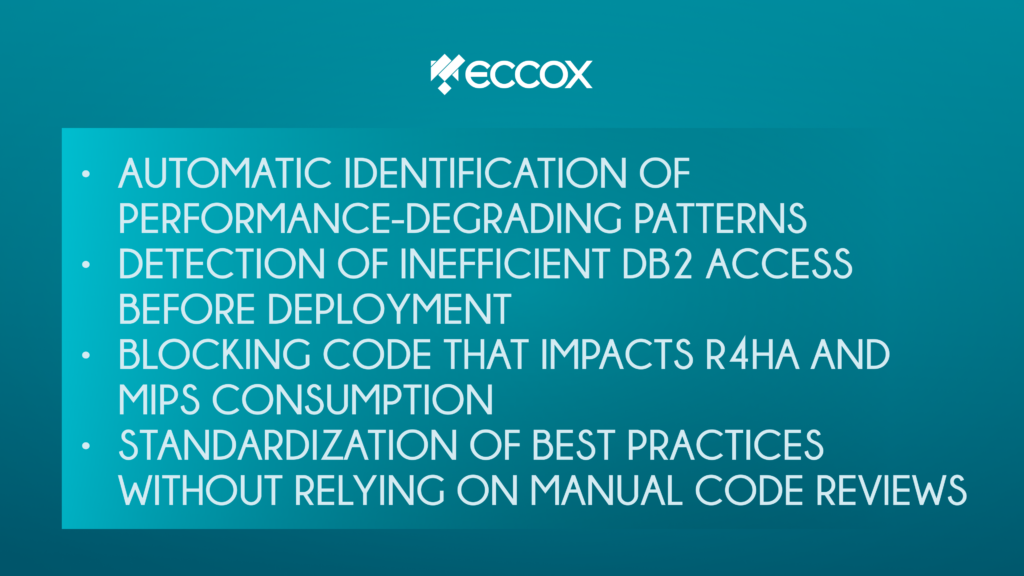
EQC is not designed to fix problems after deployment. Its purpose is to prevent them from reaching production in the first place.
In practice, this means:
The benefit is not only technical—it is structural. Instead of reacting to a batch process that has already exceeded its execution window, the objective becomes preventing degradation before it happens.
Operations managers and DBAs move beyond routine execution and become efficiency managers.
The batch window has not disappeared. It has simply been compressed until it became a continuous operational challenge. Solving this challenge is not about adding more computing capacity. It is about understanding, controlling, and optimizing what is actually being executed.
In this context, mainframe modernization is not about moving workloads elsewhere. It is about making every processing cycle more efficient, predictable, and sustainable.
When code quality becomes part of operations, results appear quickly:
- Batch processing completes on time again
- Resource consumption stabilizes
- Costs stop growing uncontrollably
- The mainframe returns to what it does best: operating efficiently, predictably, and sustainably—even under continuous workloads.
If your batch window is under constant pressure, the problem may not be time itself. It may be what is running inside it.