



For a long time, the discussion around mainframe modernization was framed as a binary choice: keep the legacy or move to something new. The reality of mission-critical environments has never worked that way.
The systems that process payments, move bank accounts, and sustain financial operations continue to execute billions of transactions within the mainframe. What has changed is the expectation around how fast these applications need to evolve.
Today, users expect continuous updates, regulators demand fast responses, and new products need to reach the market in weeks. As a result, modernization is no longer a platform discussion — it has become a development flow discussion.
COBOL remains relevant, that’s a fact. The question is: how do you integrate it into a pipeline that aligns with cloud-native standards?
The challenge is not the code
Most bottlenecks in z/OS environments do not come from the platform’s capacity, but from how development is structured. Isolated repositories, manual promotion processes, and dependence on specialists create a gap between business speed and delivery speed.
The impact shows up in everyday operations:
- Increased lead time
- Lack of traceability
- Higher operational risk
- Dependence on individual knowledge
While part of the organization operates with Git and automated pipelines, another still relies on workflows designed for quarterly releases. The consequence is not technical — it’s operational.
Git and Jenkins: when the mainframe speaks the same language as the rest of the company
Adopting Git in COBOL environments is about creating a shared standard across platforms. When mainframe code enters the same versioning flow as distributed applications, silos disappear.
The same applies to Jenkins. Automating build, test, and deployment removes manual steps and introduces predictability. In practice, COBOL starts following the same continuous integration flow:
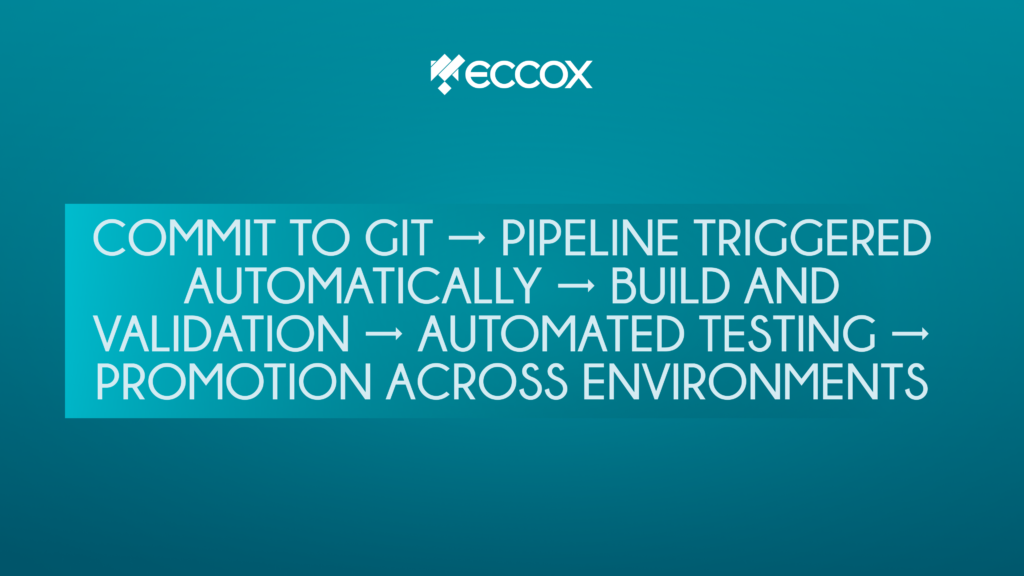
he gain is not just speed. It’s control.
There’s a simplified view that modernization means replacing the core. In environments that truly scale, the opposite happens.
The mainframe continues processing what is critical. Microservices and APIs expand its ability to integrate with the outside world.
This architecture preserves decades of business logic while enabling connections to Open Finance, mobile banking, and new digital channels. Modernization happens around the core, not against it
.
zCX and Docker: cloud-native inside z/OS
z/OS Container Extensions (zCX) is a turning point, enabling Docker containers to run directly within the z/OS environment. This brings the mainframe closer to cloud-native models without requiring disruptive restructuring.
The impact is immediate:
- Open-source tools running close to the data
- Reduced latency
- Simplified hybrid architecture
- Less dependence on distributed infrastructure
- Operational consistency across platforms
What once required multiple environments can now coexist within the same ecosystem, with near-zero latency and centralized governance.
This is where many modernization efforts stall: the code and the pipeline evolve, but the data remains stuck.
Automated pipelines cannot sustain speed when provisioning test environments takes days. In systems with DB2, VSAM, and complex integrations, data consistency becomes as critical as the code itself.
Without it, continuous integration becomes partial automation.
Eccox APT: Continuous Testing in Real Mainframe Environments
Eccox’s experience in mission-critical environments shows that the speed of a CI/CD pipeline performance depends not only on the code itself, but also on the availability of reliable testing environments.
Eccox APT (Application for Parallel Testing) addresses this challenge by automating the creation of isolated test tracks within the IBM z/OS environment.
Instead of relying on emulation, the solution uses real mainframe components (such as CICS, IMS, Db2, VSAM, and MQ), cloning only the elements required for each testing scenario.
This enables multiple teams to execute tests simultaneously without conflicts between applications, program versions, or shared databases, while preserving the integrity of the original environment and eliminating dependence on manual environment provisioning.
Key benefits include:
- Automated creation of isolated test tracks;
- Parallel testing using real z/OS components;
- Reuse of test plans and test cases;
- Reduced conflicts between teams and projects;
- Automated environment setup for integration and functional testing.
In practice, APT eliminates one of the biggest bottlenecks in continuous delivery on the mainframe: the time spent waiting for a testing environment to become available.
The integration of COBOL, Git, Jenkins, microservices, and containers is no longer a possibility—it is an operational necessity. Modernizing the mainframe means ensuring that the infrastructure supporting the business evolves at the same pace as market demands.
For DevOps engineers and SCM administrators, the challenge is now to ensure agility, governance, and predictability within an environment that can never stop.
If your pipeline has already evolved, but testing still depends on shared environments and manual processes, the issue is not with the pipeline itself, but with the way testing environments are managed.