



The role of the mainframe used to be relatively easy to explain: securely process and record critical transactions with high availability and at scale. Banks, insurers, retailers, governments, and large enterprises built on it what the industry came to call the system of record.
That role has not disappeared. What has changed is what the rest of the organization expects from that data.
Applications need to respond in real time. AI models need context. Analytics systems need visibility into events as they happen. Digital channels need to combine information held in the core with data distributed across APIs, cloud environments, applications, and other platforms.
According to Kyndryl’s State of Mainframe Modernization 2025 survey, 88% of organizations said they are implementing or planning to implement AI in their mainframe environment. At the same time, 99% of respondents operate in hybrid environments.
The question, therefore, is no longer simply whether the mainframe will be part of the AI strategy.
The question is how to turn data and events generated in the transactional core into inputs for intelligent applications without dismantling the architecture that still supports the business.
This is where the idea of an intelligent core starts to make more sense.
The system of record is still necessary, but it is no longer enough
Storing an organization’s transactional truth and being able to use it at the moment when it can create value are two different things.
A card transaction may be perfectly recorded on the mainframe, but a fraud detection system needs to analyze it as it happens.
A financial transaction may be fully consistent within the core, but a customer service application may need to immediately combine it with information from other channels.
An insurance company may have decades of reliable historical data, but an analytics model or AI-enabled application needs access to relevant information within a much broader context.
The problem is not the reliability of the system of record. It is the distance between the data existing and the data being available for decision-making.
Trying to bridge that distance simply by extracting everything from the mainframe creates another problem.
For many years, analytics projects followed the familiar model of extracting data from transactional systems, copying it to another environment, transforming it, and only then using it for analytics, applications, or models.
That model is still valid in many situations. But the closer a decision needs to be to real time, the more complex that chain becomes.
Between an event occurring and that event being used, organizations may introduce:
- Additional copies;
- ETL processes;
- Data lag between systems;
- Multiple versions of the same information;
- New security controls;
- Data movement and storage costs;
- Governance challenges.
With AI, the tension increases.
The more data is replicated to feed different applications and models, the larger the surface area that must be protected, governed, and kept consistent.
Kyndryl’s research highlights this challenge. Among organizations advancing their use of AI on the mainframe, 47% cite restrictive security protocols that limit access to data, while 37% point to regulatory and compliance requirements as barriers to implementation.
The challenge, therefore, is not simply to “open up” the data. It is to make it usable without losing the controls that made the environment trustworthy in the first place.
This is where the discussion moves beyond infrastructure and becomes a question of data architecture.
An intelligent core is not a mainframe attempting to perform every function of a modern architecture on its own.
Nor is it an environment in which transactional data is gradually drained away until all of its value resides on another platform.
It is an architecture in which the core continues to do what it does best, while its data, events, and rules become part of new digital flows in a controlled way.
That requires a layer capable of connecting different worlds.
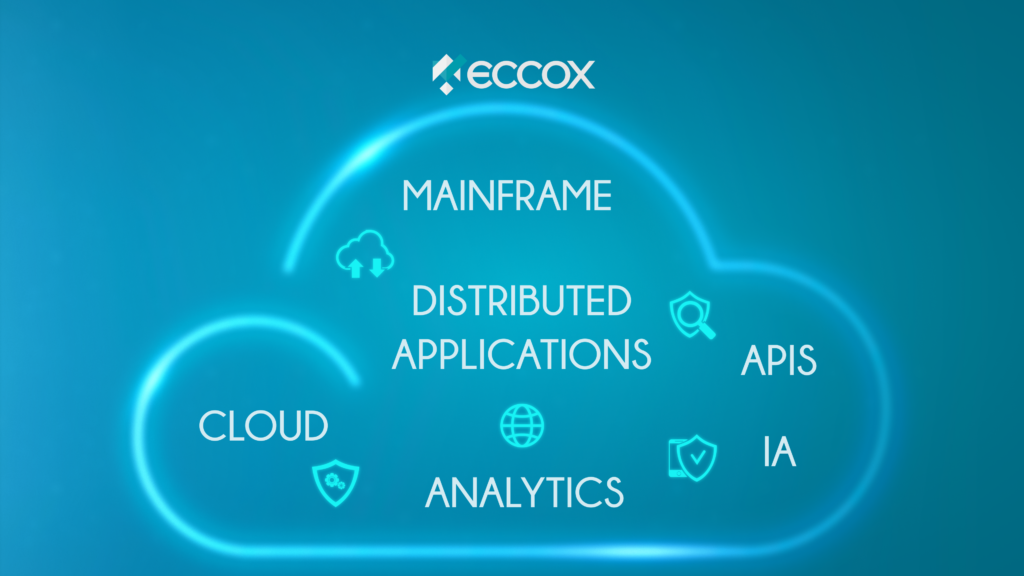
Instead of asking, “Where are we going to put all the data?”, the architectural question becomes: how can different applications work with the data they need, with context, governance, and less friction?
InterSystems IRIS: a layer between data, applications, and intelligence
This is precisely where InterSystems IRIS comes in.
InterSystems defines IRIS as a cloud-first data platform that combines data management, interoperability, transactional processing, and analytics. The platform supports SQL and NoSQL and enables transactional and analytical workloads to run simultaneously on a single engine.
This matters because the role of IRIS in this architecture is not to replace the mainframe as the critical transactional system. It is to reduce the distance between the core and the applications that need to work with its data.
Its interoperability layer provides connectivity across APIs, services, databases, and different protocols and technologies. The platform also includes capabilities for process orchestration, API management, business rules, and event processing.
In practice, this makes it possible to build a layer in which data from different systems can be connected, transformed, and used by new applications without requiring every project to rebuild the entire integration stack from scratch.
The mainframe continues to execute the transaction. IRIS helps connect that transaction to the rest of the digital ecosystem.
That distinction becomes even more important when the conversation reaches artificial intelligence. A model does not simply need access to data. It needs relevant, contextualized, and governed data.
Imagine an AI application analyzing fraud risk. The financial transaction itself is only part of the context. Other relevant factors may include:
- Recent customer behavior;
- Historical activity;
- The channel being used;
- Location;
- Previous events;
- Internal rules;
- Information coming from other systems.
None of these sources, in isolation, represents the full situation.
The problem stops being about storing information and becomes one of connecting enough information to produce a better decision.
That is why an AI-ready architecture needs to solve interoperability before it solves modeling alone.
Without that foundation, an organization may end up with increasingly sophisticated models working on increasingly fragmented data.
A recent move by InterSystems makes this architecture even more concrete. In 2026, the company introduced the InterSystems IRIS AI Hub, positioning it as a governed layer between AI applications and existing data systems.
This is particularly relevant in mission-critical environments.
During the first wave of generative AI, much of the discussion focused on the model itself. Which LLM? Which platform? Which capabilities?
Now, the bottleneck is increasingly becoming which data AI can access, with what context, under which rules, and without creating yet another silo.
The differentiator in an intelligent architecture will not simply be bringing AI closer to the business. It will be doing so without losing governance over the data that supports the business.
Transactions and analytics do not need to live in separate universes
Another architectural legacy now being questioned is the rigid separation between operational and analytical environments.
In the traditional model, the transactional environment does one thing. The analytical environment does another.
Data is extracted from the first and prepared for the second. But modern applications often need both capabilities.
A decision may depend on a transaction happening right now and, at the same time, on historical data that helps interpret it.
InterSystems IRIS was designed to support transactional processing and analytics simultaneously, while also allowing analytics, machine learning, business rules, and AI capabilities to be embedded into applications.
That does not mean moving all analytical processing onto a single platform. It means reducing the need to treat “operational” and “intelligent” as two completely separate worlds.
Bringing those worlds closer together is one of the foundations of the intelligent core.
There is also a semantic risk in this discussion. Talking about an “intelligent core” may suggest a return to an architecture in which everything needs to be concentrated in one large central system.
It is the opposite.
Today’s enterprise environment is hybrid by nature.
Kyndryl’s research shows that virtually all surveyed organizations operate this way, combining mainframes with other platforms and pursuing modernization through different paths.
The intelligent core does not centralize everything. It participates more effectively in the ecosystem.
The mainframe can remain responsible for the critical transaction. A cloud application can manage the digital experience. Another platform can run a particular model. An external service can enrich a decision. An interoperability layer can connect those components.
The intelligence lies less in putting everything in the same place and more in ensuring that each component receives the right information, at the right time, under the right rules.
Organizations have been dealing with data silos for decades. AI may solve part of that fragmentation, but it may also multiply it.
Each new project can create its own pipeline, its own copy of the data, its own vector database, its own set of permissions, and its own interpretation of the truth.
Before long, the organization moves from application silos to intelligence silos.
InterSystems positions IRIS as a platform capable of connecting data and application silos while supporting the development of high-performance, AI-enabled applications.
That is why data-driven modernization should not begin with the AI model. It should begin with the architecture that will allow that model to find reliable data.
Modernizing the mainframe also means enabling it to participate more effectively
There is a tendency to associate modernization with replacement. But in a hybrid architecture, modernization often means increasing the ability of an existing system to participate.
Securely expose a function. Connect an event to another flow. Make data available to an application. Orchestrate processes across platforms. Enable analytics or AI to use information from the core without requiring a complete rebuild.
The mainframe stops being seen only as the place where the transaction ends. It also becomes one of the most important sources of context for what happens after that transaction.
The system of record remains essential because organizations still need to know which version of a transaction is authoritative. AI does not eliminate that need. In fact, it makes it even more important.
The greater the ability to automatically generate responses, recommendations, and actions, the greater the need to know which data those decisions are based on.
That is why the next stage of modernization does not necessarily require replacing the core. It requires connecting it.
Through its partnership with Eccox, InterSystems IRIS fits into this layer of data-driven modernization: connecting different applications and data sources, enabling interoperability, and creating a foundation for analytics and intelligent applications without making mainframe replacement a prerequisite.
Because the challenge for organizations is no longer just to process billions of transactions reliably. It is to turn those transactions into context for the next decision.
And it is this transition — from the system that records to the core that participates, connects, and informs — that is beginning to define what an intelligent core really means.