




On the mainframe, performance degradation does not usually begin with an obvious failure. It tends to emerge gradually: more pages being read, increased fragmentation, less efficient indexes, and maintenance operations taking longer and longer.
By the time the impact finally reaches the application, the problem is no longer purely technical.
This is one of the reasons why Db2 data reorganization needs to be treated as part of the operational strategy, rather than simply as a recurring DBA task.
IBM itself defines REORG TABLESPACE as the utility responsible for reorganizing table spaces and partitions to reclaim fragmented space and improve access performance. For indexes, REORG can also reclaim fragmented space and improve access efficiency.
Once we recognize that reorganization matters — and matters a great deal — the question becomes how to decide when it should happen, with what impact, and at what operational cost.
The problem with calendar-based maintenance
For a long time, the logic was relatively simple: define maintenance windows, run REORG at known intervals, and try to keep the database organized before degradation became noticeable.
That model still works in many scenarios, but it has one clear limitation: time is not necessarily the same thing as need.
An object may reach its scheduled maintenance date without actually needing reorganization. Another may begin to degrade before the next maintenance window.
Db2 documentation itself recommends running REORG when a need has been identified. Fragmentation, clustering degradation, structural changes, and certain object states are among the indicators that may justify reorganization.
IBM also points out that less-than-ideal statistics do not automatically mean a REORG should be performed.
The question then becomes:
“Which objects actually need REORG right now?”
It may sound like a small distinction, but it separates routine-based maintenance from condition-based management.
The main point to keep in mind is that REORG is not free.
It moves data, consumes resources, has to coexist with applications, and may require careful planning to avoid affecting critical workloads.
Even Db2’s native capabilities require decisions around concurrency, partitioning, indexes, low-activity periods, and the levels of access allowed during reorganization.
IBM recommends particular care when running online REORG and notes that parallelizing reorganizations can reduce elapsed time, even though aggregate processor consumption may increase.
At the operational front line, DBAs are caught between two risks:
- Reorganizing too little: fragmentation and disorganization can degrade access and performance.
- Reorganizing too much: reorganization consumes capacity and maintenance time even when the benefit does not justify the execution.
That balance becomes harder to manage as the environment grows.
More applications mean more objects. More data means more decisions. More 24/7 operations mean less room for intrusive maintenance.
This is where Db2 reorg automation stops being an operational convenience and starts becoming part of capacity and availability management.
REORG should not compete with the business
Another important structural shift is that the window in which organizations could simply “stop and reorganize the database” is becoming increasingly narrow.
Banking applications, instant payments, APIs, digital channels, and integrations operate continuously. The database cannot simply become unavailable because it is time for maintenance.
That is why the reorganization challenge today is not only about speed, but also about maintaining availability while maintenance is taking place.
BMC positions BMC AMI Utilities for Db2 specifically in this space.
The solution brings together Db2 data management utilities within a centralized architecture and uses adaptive automation to manage processes including reorganization, copy, recovery, load, and other maintenance activities.
That difference matters because it changes the relationship between maintenance and availability. The two no longer need to be treated as inherently conflicting goals.
BMC AMI Utilities for Db2: automating the decision, not just the execution
REORG automation can be understood superficially as “running the same job automatically,” but that is not the most interesting problem to solve.
The greater benefit lies in adapting operations to the actual conditions of the environment.
BMC AMI Utilities for Db2 combines data management utilities with automation capabilities to simplify complex processes and handle large volumes of objects.
BMC highlights algorithms capable of managing buffering, performing lower-level I/O, and processing thousands of objects within a single statement, in addition to supporting online reorganization processes.
This is the shift in logic:
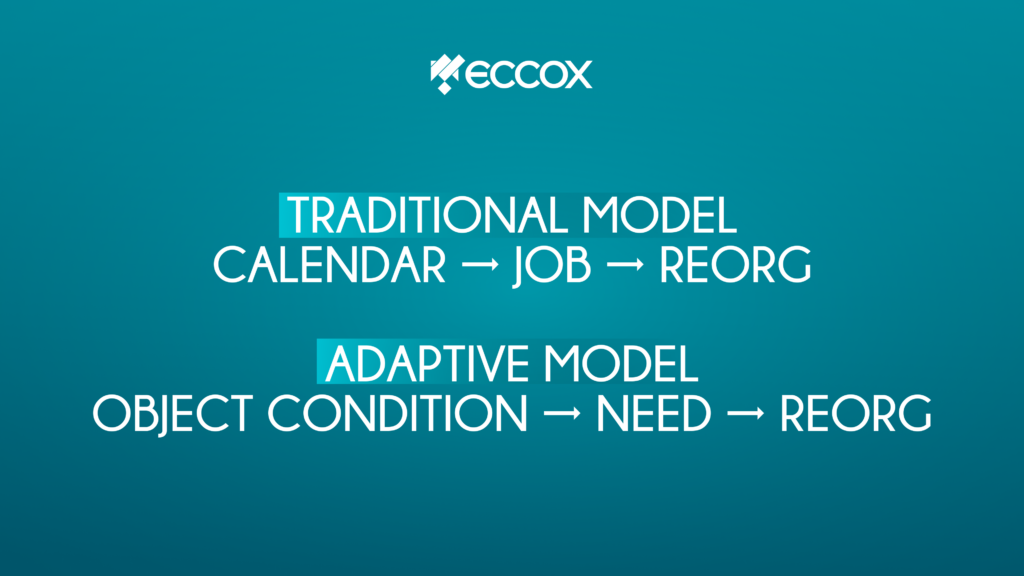
Automation stops serving only to eliminate manual work and starts helping reduce unnecessary interventions.
Visibility is also part of automation
Another risk of automation is turning invisible processes into even more invisible ones.
If no one knows what was executed, in which subsystems, how often, or why, automation may reduce operational work without necessarily improving governance.
That is why the visibility layer matters.
BMC provides dashboards for monitoring utility usage, and this information can support strategic decision-making.
Runtime Insights capabilities make it possible to monitor utility executions across different Db2 subsystems and identify where activity is concentrated, helping teams analyze performance, resource utilization, and workload distribution.
This shifts Db2 management away from a purely reactive model — “The database became slow. What happened?” — toward a more preventive one:
“Object behavior is changing. What do we need to do before it affects the application?”
Data management is no longer just a DBA concern
It is easy to treat table space and index reorganization as an overly technical issue, but the effects extend beyond the database team.
When performance degrades:
- transactions take longer;
- applications become less predictable;
- SLAs come under pressure;
- teams spend more time investigating incidents;
- maintenance starts competing with business workloads for resources.
On the other hand, indiscriminate maintenance also comes at a cost.
The discussion, therefore, is about using capacity when it creates value and preserving availability when the business needs it.
That matters to DBAs, but also to operations, architecture, capacity planning, and infrastructure leadership.
In mission-critical environments, data management is not housekeeping. It is part of operational continuity.
The database does not need to be slow for there to be a problem
This is the biggest risk of management based solely on symptoms: by the time slowness becomes visible, degradation may already have been developing for some time.
Fragmentation does not send an alert to the user.
A degraded index does not appear on the business dashboard labeled “reorganization problem.”
Modernizing Db2 management means reducing the gap between technical conditions and operational decisions.
It is not about running more REORGs. It is about running them when there is a reason, keeping data available, and turning maintenance into a predictable and observable process.
That is the shift adaptive automation makes possible.
If your Db2 maintenance strategy still relies mainly on the calendar, manual intervention, and reacting to degradation, perhaps the problem is not that the database is slow.
Perhaps you simply do not yet have enough visibility to notice when it starts becoming slow.