



The market often treats the shortage of mainframe professionals as an unavoidable problem. A natural consequence of an “old” technology that is difficult to learn and disconnected from younger generations. That interpretation is convenient and, in most cases, wrong.
The problem is not a lack of interest. It is the experience.
While modern developers work with intuitive interfaces, automated pipelines, and widely adopted languages, many mission-critical environments still require an onboarding curve built around unfamiliar tools, fragmented processes, and dependence on specialists.
That does not drive talent away because of a lack of ability. It drives talent away because of a lack of context. And today, context is everything.
The generational gap is not technical. It is operational. The new generation does not necessarily reject the complexity of the mainframe. The real challenge is working in environments that offer less automation, integration, and autonomy than the ones these professionals are already used to.
When a developer needs to learn COBOL within a workflow that does not connect with the rest of the organization, the problem is not the language. It is the isolation. When the environment requires waiting, queues, and manual validation, the problem is not the system. It is the model.
That is where the talent shortage begins to take shape.
What drives new professionals away is not the mainframe itself, but:
- less accessible interfaces
- lack of integration with modern tools
- constant dependence on specialists
- environments that do not allow experimentation
Meanwhile, the rest of the organization already operates under a different logic: autonomy, fluidity, and rapid feedback.
Modernization Means Making the Environment Livable
The mainframe modernization discussion usually revolves around performance, cost, and architecture. All of that matters, but there is a layer that comes before it: who is actually able to work in that environment.
Modern tools are not an aesthetic luxury. They are what turns a closed environment into an accessible one.
When developers can work with VS Code, web interfaces, and languages such as Python, the mainframe stops being an isolated territory and becomes part of the broader development ecosystem.
The change is not superficial. It changes the relationship with the system.
What changes in practice? The table below translates that difference directly:
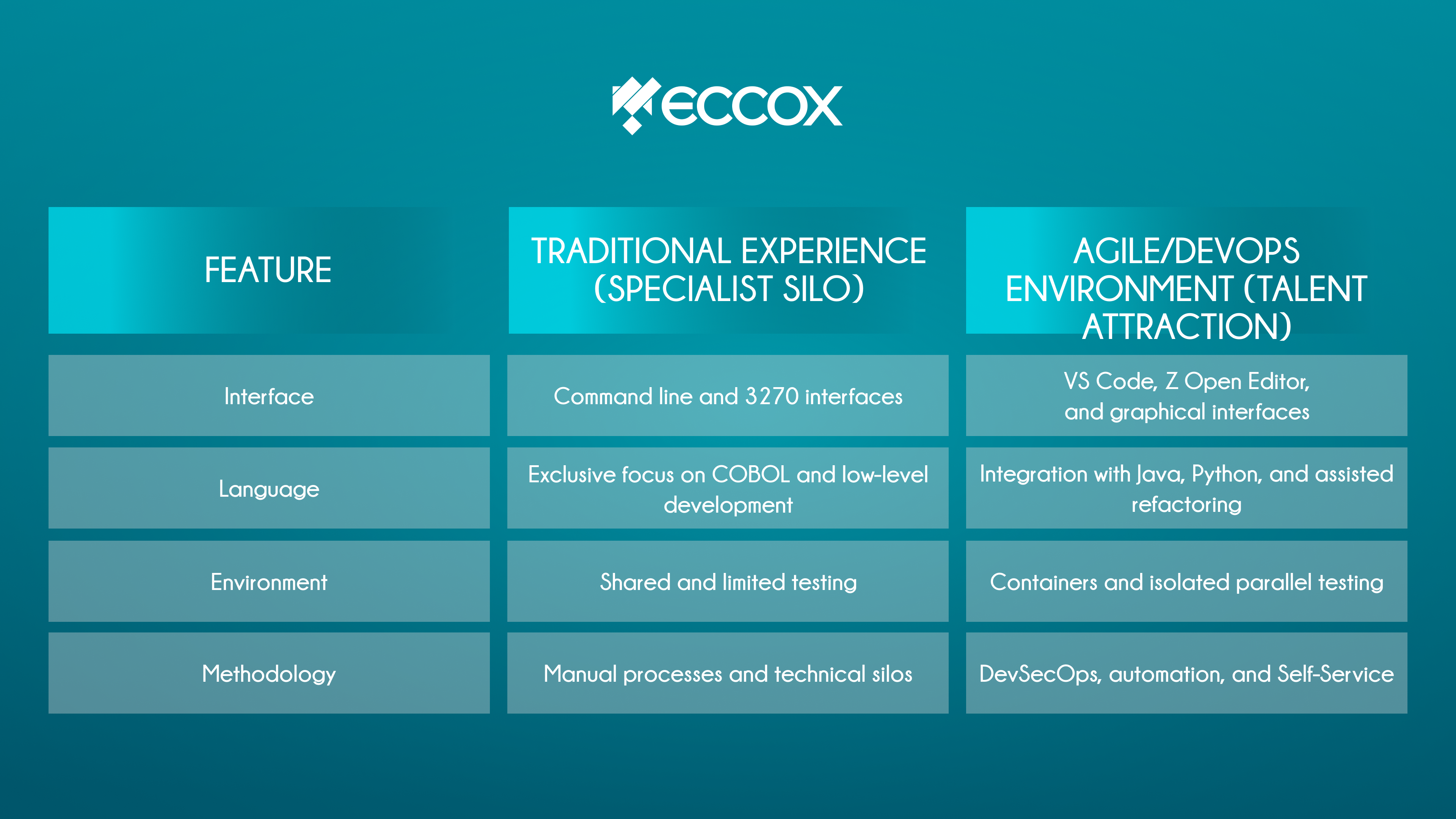
This is not about replacing what already exists. It is about connecting what exists to what has already become standard outside it.
There is one point in the development of new professionals that is rarely discussed: no one learns where they cannot test.
Restricted environments, dependent on approvals and carrying a high risk of production impact, create an immediate effect: learning and autonomy slow down. Developers begin to avoid experimentation, mistakes become operational risks, and knowledge tends to remain concentrated in a small number of specialists.
This is where the generational gap becomes entrenched. Without practice, there is no transition. Without transition, knowledge ages.
APT: When Autonomy Becomes Part of the Culture
Eccox APT (Application for Parallel Testing) fits into this context not merely as a testing tool, but as infrastructure for learning and productivity.
By allowing developers to create their own isolated environments with real data and applications, APT removes the main barrier to entry: dependence.
In practice, this means:
- autonomy to test without waiting
- parallel environments without conflicts between teams
- freedom to learn without operational risk
- scenario repetition to reinforce knowledge
The impact is not only technical. It is cultural. The environment stops being a space controlled by a few and becomes a system in which knowledge can circulate.
Over more than three decades, Eccox has built something that does not appear in architecture diagrams or roadmaps: continuity of knowledge. In mission-critical environments, that is worth as much as any technical evolution.
Modernization is not about discarding what has been built. It is about ensuring that it continues to make sense for those who come next.
Eccox operates precisely in this transition: connecting established engineering with modern practices, without losing what sustains the operation.
How to Move Beyond the Discussion and Start Closing the Gap
Solving the mainframe talent shortage does not come down to a single decision. It requires a sequence of adjustments that, together, change the environment.
In practice, the shift usually involves four fronts:
- Understand where the risk already exists: Map areas that depend on only a few people, especially where knowledge has been concentrated for years. This is not only about retirement. It is about continuity.
- Create space for real knowledge exchange: Bringing experienced professionals and new generations closer together does not happen through messaging alone. It depends on environments that encourage collaboration and continuous knowledge transfer. Centers of excellence, hybrid squads, and shared projects accelerate this transition and reduce dependence on a small number of specialists.
- Make the environment accessible: Modern tools are not minor details. They are what allow someone to enter the environment and actually operate within it. Familiar IDEs, broader language support, and accessible testing environments reduce the learning curve.
- Remove friction from everyday work: Automation, self-service, and less dependence on queues are not only productivity gains. They are also what keeps people engaged with the environment.
Minimum Checklist to Get Started
- Map critical dependence on specialists in key areas
- Open the environment to modern tools (VS Code, Z Open Editor)
- Enable testing without queues or dependence on third parties
- Create space for learning without operational risk
The Future of the Mainframe Depends on Who Can Work With It
The talent shortage will not be solved by hiring more specialists. It will be solved when more people can operate the environment naturally.
That requires two things:
- tools that bring people closer, not push them away
- environments that allow people to learn, not merely execute
Everything else follows from that.
If your environment still depends on a small number of people to function, the problem is not a lack of talent. It is a lack of access.