




Most people will never think about what happens between sending a Pix payment and having it received—and that’s precisely the point. Some technologies are built to be seen, while others exist to ensure the world never stops.
The mainframe has always belonged to the second group. It doesn’t appear in social media feeds, become a trend, or dominate conversations about “the future of technology.”
Yet it continues to process billions of transactions, supporting banks, insurance companies, and mission-critical operations that simply cannot fail. That reality has shaped a very particular kind of community.
People Who Work on Systems That Cannot Stop Think Differently
While much of the technology market moves through rapid cycles—a new language, a new framework, a new stack—the world of mission-critical computing operates at a different pace.
Here, replacing everything is not innovation, breaking things is not a learning experience, and “testing in production” is not an inside joke.
What sustains this environment is a different set of values: continuity, technical memory, predictability, and shared responsibility. It is not a place to experiment. It is a place to understand.
The mainframe community has its own unwritten codes, often expressed through humor. The classic “mainframe is dying” joke has circulated for decades, resurfacing every time a new wave promises to replace legacy systems once and for all—and aging poorly every single time.
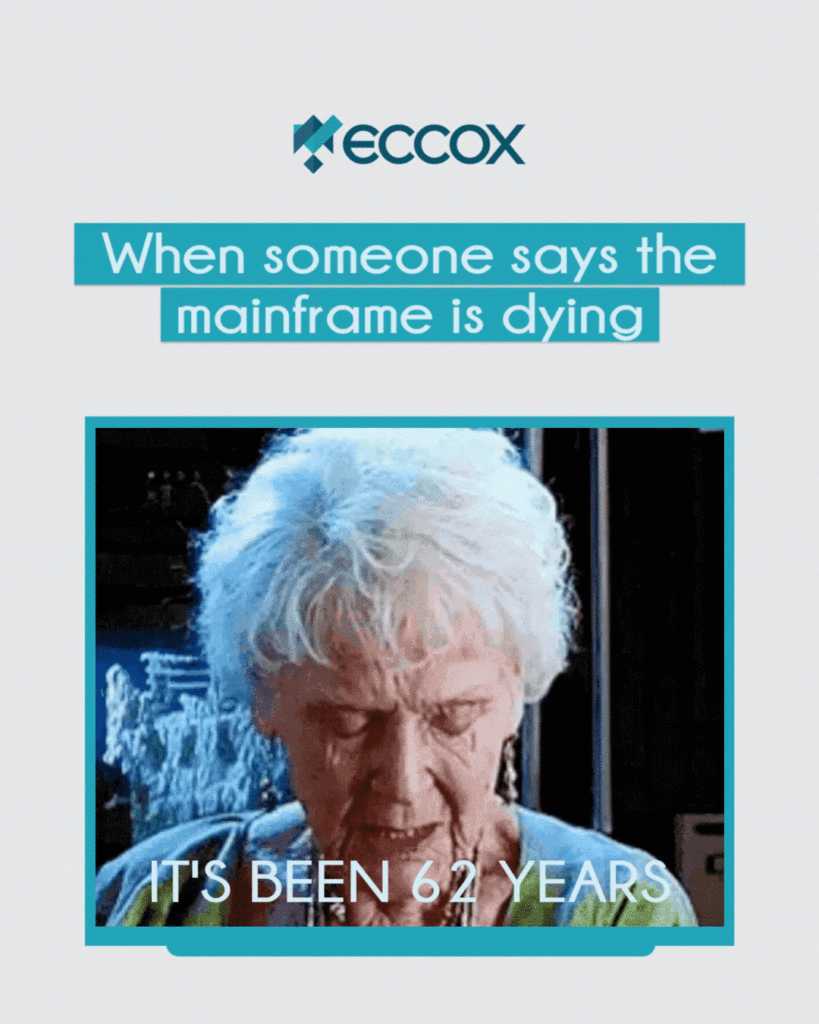
It is not that the technology fails to evolve. It is that reality is far more complex than the narrative.
These memes serve as collective memory. Anyone who works with mission-critical systems has watched countless technology waves come and go—and only a few have truly replaced what cannot afford to fail.
It Has Never Been About Loving COBOL
The superficial assumption is that mainframe professionals are simply attached to the past. In reality, they operate under a different value system.
Some people enjoy launching new user interfaces. Others make sure every transaction works.
Some build what people see. Others sustain what people depend on.
That difference shapes the way they think: understand before changing, predict before executing, validate before trusting. It is not a lack of interest in innovation—it is an abundance of responsibility for what already exists.
Mission-critical environments are sustained by more than technology. They depend on something far less visible: human continuity.
These are professionals who spend years—sometimes decades—understanding complex systems, accumulated business rules, and relationships that exist nowhere in documentation. This kind of knowledge cannot be scaled overnight. It is built through time, collaboration, and the transfer of experience from one generation to the next.
That is why the engineering culture is different: less individual protagonism, more collective responsibility.
Where Eccox Fits Into This Story
Companies operating in this space naturally absorb the same mindset. For more than three decades, Eccox has grown by supporting systems that cannot stop, connecting different generations of professionals while helping the ecosystem evolve without compromising the foundations that keep operations running.
Here, modernization has never meant replacing technology for the sake of replacing it. It means evolving without losing control.
The company’s culture is built around practical engineering: automation that removes real operational friction, testing that prevents real business risks, governance that creates predictability, and integration with modern technologies without compromising what already works.
Perhaps the greatest irony in this industry is also the least discussed: when everything works, nobody notices; when something fails, everyone does.The goal has never been visibility. It has always been continuity.
That is why mainframe culture is less about being seen and more about ensuring that no one ever has to think about what happens behind the scenes.
Keeping the invisible running requires consistency over time and a level of commitment that cannot be measured by technology trends, but by trust earned one operation after another.
In the end, it has nothing to do with preferring old technology or new technology. It is about choosing to work with systems that cannot fail—and accepting everything that comes with that responsibility.