



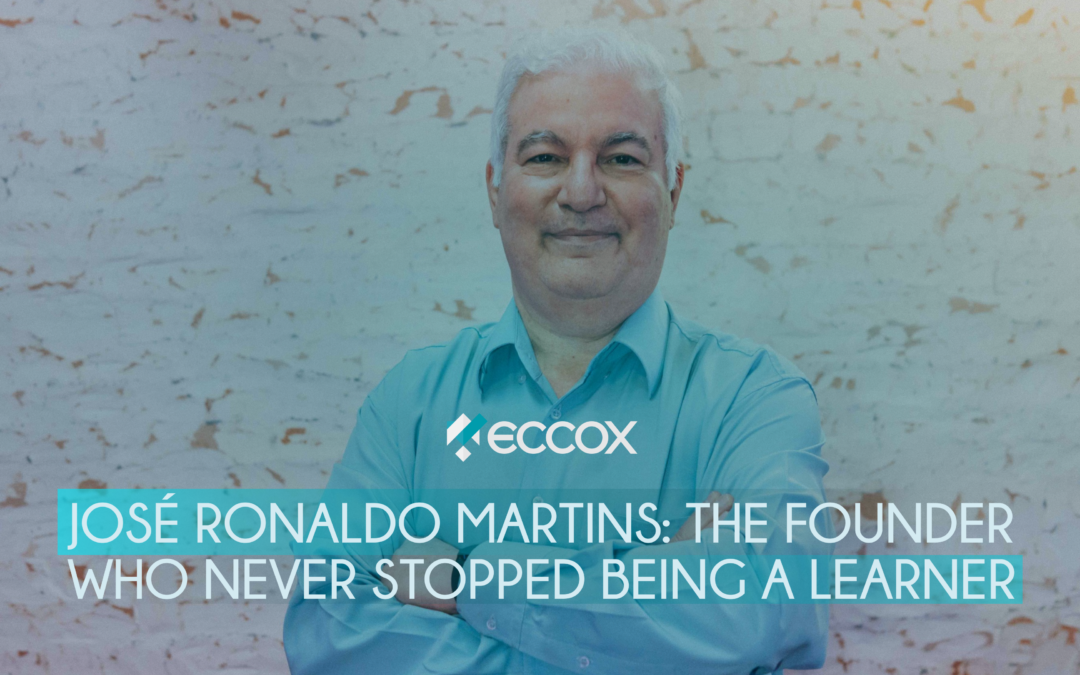
It was already too late when Ronaldo realized that Aline’s “restless little scissors” had claimed another victim.
When his daughter was still very young, he discovered that one of the issues of Ciência Hoje magazine had been completely cut to pieces by her tiny hands.
There wasn’t much he could complain about. It wasn’t her fault.
At home, there was a rule: anything left in a certain compartment of the desk was fair game as a toy. That day, by mistake, a newly arrived magazine had ended up right there.
He hadn’t even read it yet! He had to go out and buy another copy.
The collection, however, remains intact decades later. For nearly twenty years, Ronaldo subscribed to the magazine, and to this day he keeps the issues carefully bound at home.
They are both a record and a physical embodiment of a habit that José Ronaldo Martins has never abandoned: studying.
Those who know him tend to immediately associate him with mainframes, COBOL, Eccox products, or the technical discussions that have spanned decades of enterprise computing evolution.
But the trait that defines him best is something else. Ronaldo never stopped being a student.
Aline grew up. So did Rodrigo, his eldest son. Alongside his wife, Zilda—with whom Ronaldo has shared his life for more than four decades—they witnessed firsthand a routine in which curiosity and work were never separate.
Disciplined curiosity
Even as a teenager, while many people spent their free time playing sports or pursuing other distractions, he preferred books.
“I’ve always been a pretty big nerd. Today people call it being a nerd; back then, there were other names for it. I would just study. I didn’t play soccer, didn’t play sports, didn’t do anything, really. I just buried myself in books.”
He graduated in Electrotechnics from the Federal Technical School of São Paulo, studied Physics at the University of São Paulo (USP), and even worked in radiation protection, inspecting facilities where radiopharmaceuticals distributed to hospitals across the country were produced.
“Radiation has no smell, no color. It doesn’t make things hot or cold. You don’t feel anything. But it’s there, doing its work,” he recalls.
Perhaps that was where he developed a perspective that would stay with him for the rest of his life: an attentiveness to invisible structures, to what keeps complex systems running without almost anyone noticing.
Years later, that same perspective led him to programming.
After a lengthy selection process at Prodesp, he joined the company as a programmer at a time when personal computers were still far from being part of everyday life in Brazilian businesses.
Over time, he became increasingly drawn to a particular kind of problem: those that required understanding how platforms worked internally, far beyond the interface users could see.
It was an unusual profile.
“We were always doing some pretty crazy things in programming.”
Throughout the 1980s, he worked at government agencies, banks, and large companies until he met Maurício da Costa e Silva. The two quickly discovered that they shared a rare characteristic: they actually enjoyed the problems everyone else avoided.
It did not take long before they started hearing the same recommendation from colleagues and clients: “Give it to them.”
It wasn’t necessarily because they were the fastest or offered the cheapest solution, but because there were challenges so difficult that few people even knew where to begin.
In the early 1990s, one of those problems would end up changing their lives.
While working during the day, Ronaldo and Maurício crossed São Paulo every night to develop a technical solution that the market did not yet offer. They became familiar customers at a pizza place along the way and spent countless nights programming on borrowed machines until, in February 1992, they officially founded Eccox.
There was no investment round, accelerator, or business plan carefully laid out in a presentation. There was a problem and two engineers convinced it could be solved.
Their first product reflected exactly that origin. It was called ShareVSAM and addressed a highly specific bottleneck in the mainframe world: allowing online processes and batch routines to share updates to critical files while preserving data integrity.
“We basically founded the company to sell that product. Then other crazy ideas started coming along.”
It was such a discreet piece of software that practically no one ever saw it working. It had no sophisticated screens or elaborate reports. It operated beneath the surface, exactly where problems tend to originate.
Ronaldo remembers a meeting with a marketing agency when he was trying to present the product.
“The guy asked, ‘But do you have any screens, any reports?’ I said, ‘No, there’s nothing. It works behind the scenes. The most I had was a log saying: opened, closed, opened, closed… It worked. That’s it.’”
How do you sell software whose greatest achievement is going completely unnoticed?
Thirty-four years later, the company remains specialized in exactly what few people ever see: the deeper layers of infrastructure that keep critical applications running without interruption.
The in-house oracle
More than a company, a way of working was born: tackling difficult problems without shortcuts, deeply understanding how technologies work before proposing any answer.
That philosophy remains alive more than three decades later.
Today, when someone joins Eccox and needs to unravel a particularly complex challenge, there is a good chance they will hear the automatic recommendation: “Talk to Ronaldão.”
Now serving as Chief Enterprise Architect, Product Owner, and Director of Research and Development, he continues doing what he has always done: studying.
“I’m extremely technical. Researching these things comes naturally to me because I’ve been on this path for almost fifty years. I’m always reading something, researching, seeing what has changed.”
He is the one who dives into developments across the IBM ecosystem, researches new technologies, challenges assumptions, takes part in the most delicate technical discussions, and helps transform knowledge into products that support the critical operations of some of the country’s largest banks.
Along the way, he participated in the restructuring of Eccox APT, led strategic projects, helped train generations of professionals within the company, and, in 2024, received the Mainframe Masters Recognition, an honor awarded to professionals who have left their mark on the history of the mainframe ecosystem. To those who know Ronaldo, the trophy is merely a detail.
The cut-up issue of Ciência Hoje was eventually replaced. The curiosity wasn’t.
It still occupies space on bookshelves, in technical conversations, in discussion groups, in the research that precedes new products, and in the way Ronaldo approaches every difficult problem that comes his way.
After more than four decades in the profession, he still seems remarkably similar to that same boy who preferred studying while the rest of the world was busy doing something else.
That may be the most accurate way to describe José Ronaldo Martins, because it says more about him than any organizational chart ever could. After all these years, he is still doing exactly the same thing: learning.