



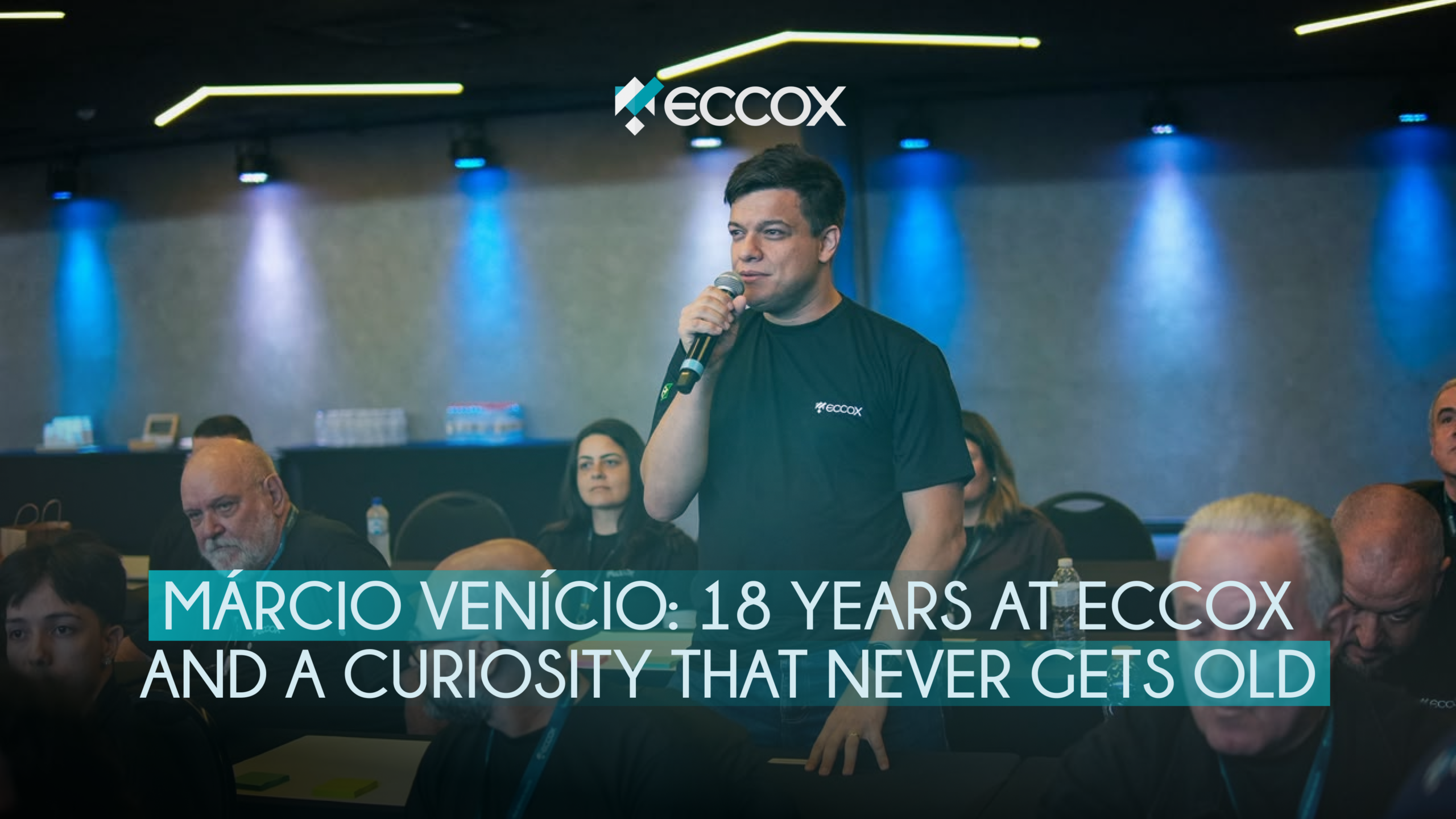
When his father brought home a 486 computer back in the 1990s, Márcio Venício Silva did not wait for anyone to explain how it worked. The machine arrived disassembled around lunchtime. By the time his father came home from work that evening, the computer had been put together and was up and running.
The story says a lot about the curious boy who grew up in Osasco, in Greater São Paulo, and who, decades later, is still interested in understanding how things work. Today, at 45, Márcio is a software engineer at Eccox Technology, where he has worked since 2008.
That means 18 years of following technological transformations, contributing to product evolution, and sharing knowledge with professionals from different generations. But his journey began long before he joined the company.
From curiosity to a career
Born in São Paulo and raised in Osasco, Márcio first came into contact with computing while still at school. His interest led him to a technical course in data processing at Fundação Instituto Tecnológico de Osasco (FITO), where, at the age of 15, he was invited to become an intern because of his performance.
The scholarship he received for his work covered his own school tuition. It was also during this period that he learned to explore programs and features on his own, relying on manuals and the help files available on computers.
“There was no internet to look things up, but there was the help function that came with Word. So whenever I needed something, I would press F1 and start reading,” he recalls.
The habit has stayed with him. Today, a significant part of his work still involves consulting IBM technical documentation to understand features and find solutions.
After completing his technical course, he went on to study Computer Science, also at FITO. By the age of 19, Márcio was already working professionally with mainframes, COBOL, JCL, and DB2, providing services to Bradesco.
At the time, the contracting model required him to open a company, so his father had to legally emancipate him. Responsibility came early: his first assignments involved live banking systems, where a mistake could lead to significant losses.
“When I started working, you couldn’t make mistakes, because it was production. It was live,” he recalls.
His experience with credit card systems and performance optimization helped shape a characteristic that still defines his work today: attention to detail.
A small task that became a long story
In 2008, after years working with banking applications, Márcio was invited by a colleague to join Eccox. He accepted the opportunity and began exploring another side of technology: developing tools used by the people who build and maintain mainframe systems.
He initially worked on other company products. In 2013, he became more directly involved in the evolution of Eccox APT, a solution that enables the creation of isolated environments for parallel testing.
“I was only supposed to fix one little screen. I’m still fixing it today,” he jokes.
What started as a small intervention eventually became one of the main areas of his career. Márcio helped redesign processes, developed algorithms, and improved automation mechanisms that contributed to the product’s transformation.
At the time, APT already existed, but it was still working to establish itself in the market. Prospecting efforts at Bradesco, which began in 2013, helped drive its evolution.
Márcio followed this transformation closely. Among the capabilities he developed were features to automate the creation and identification of cloned tables, which are essential for allowing different professionals to run tests without interfering with one another’s work.
To explain the complexity of these operations, he often turns to everyday examples. Bananas and pineapples, for instance, frequently appear in his explanations of logic and data differentiation.
“I use fruit a lot in my examples. It makes things easier for people to understand.”
His preference for accessible explanations is no coincidence. Márcio says that early in his career, he would sometimes spend more time writing an email to explain a fix than actually solving the technical problem.
Today, simplicity is part of his development philosophy. “The hardest thing is making things simple.”
Those who know the way can also help clear the path
With so many years of experience, Márcio has become one of the team’s technical references. His routine includes developing improvements, investigating failures, and handling requests that do not always respect the day’s original plan.
In some situations, colleagues spend hours trying to identify the source of a problem before reaching out to him. His familiarity with the product allows him to recognize situations he has already encountered before.
But Márcio knows that this experience did not come ready-made.
When he began working more deeply with APT, many of the original developers had already left the company. With limited documentation and no one who knew every detail of the solution, he had to investigate much of how the tool worked on his own.
“Back then, we were the ones clearing the path. There was no path,” he says.
Today, he tries to give younger professionals a different experience. He helps guide new talent and follows the development of colleagues such as Henrique, who joined the company as an intern and has already reached a mid-level position.
The meeting of different generations also creates some funny moments. Márcio remembers the shock of realizing that he was already working professionally when Henrique was born.
The age difference, however, does not get in the way of the exchange. On the contrary: the knowledge accumulated by more experienced professionals helps develop people who gradually gain the autonomy to take on new challenges.
Between code, toys, and trust
Married to Gabriela and father to Marcelo and Leonardo, Márcio has worked remotely since the pandemic. His office, in the family’s apartment in Osasco, also doubles as his children’s playroom.
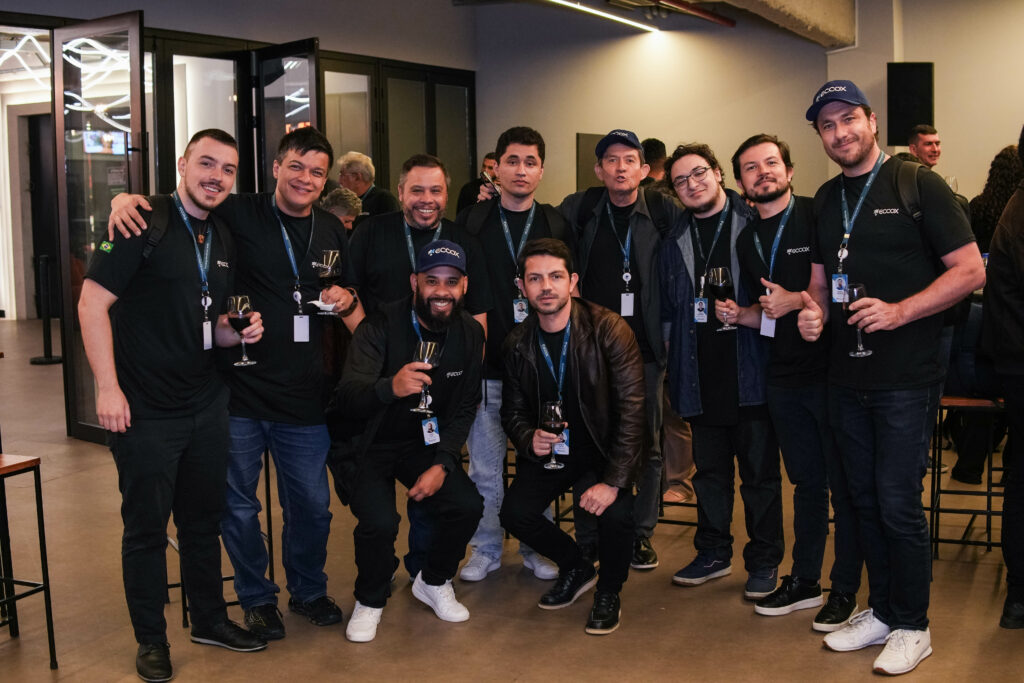
Despite the physical distance, he describes Eccox as a close-knit environment, shaped by openness and direct dialogue with leadership.
He highlights the relationship he has built with Maurício and Ronaldo over the years. That does not mean there are no disagreements: technical discussions and differences of opinion are part of everyday work. For Márcio, being able to speak openly and suggest different paths is precisely a reflection of the trust built over time.
That freedom also helps him keep doing what he enjoys.
And although he has been involved with computing for nearly three decades, he shows no sign of having exhausted his interest in the field. He continues studying, consulting manuals, and investigating possibilities within systems he already knows extremely well.
“I love this field. There’s no price you can put on doing what you love.”
After 18 years at Eccox, one of his greatest qualities remains the same curiosity that led him to assemble a computer before his father came home from work.
After all, as Márcio himself puts it: “No matter how much we know, we still know almost nothing.”