



Mainframe modernization is often perceived as a long-term initiative with delayed returns and significant risk. For CFOs and CTOs, this has created a common perception: modernization is necessary, but the financial impact takes too long to materialize.
The problem is that this assumption starts from the wrong place. The biggest cost is not the transformation itself—it is the development lifecycle that supports it.
Today’s environment no longer allows for that kind of inertia. Transaction volumes continue to grow at an accelerated pace, driven by Pix, mobile banking, and continuous integrations, while revenue per interaction fails to keep up.
The result is direct pressure on MIPS consumption and, consequently, on EBITDA. In this context, mainframe modernization is no longer just a technology initiative—it has become a financial one.
The Mistake That Delays ROI: Focusing on Code While Ignoring the Development Cycle
Many modernization initiatives still revolve around refactoring or replatforming. Both are valid strategies, but they share a structural limitation: returns are delayed because costs continue throughout the modernization process.
While the code evolves, the development lifecycle often remains inefficient:
- Slow environment provisioning
- Massive data copies
- Rework caused by broken referential integrity
- High MIPS consumption during testing
Together, these inefficiencies create a silent effect: testing becomes one of the largest cost components of the initiative, representing as much as 50% of the total investment.
If the goal is to achieve ROI within six months, the focus must shift. Costs need to be reduced while the modernization is happening—not after it is completed.
The 50/15 Goal: Turning Testing from a Cost into a Business Lever
The fastest way to improve the financial return of a modernization initiative is to eliminate what could be called the “testing tax.” In traditional environments, testing is expensive because it depends on scale, large data volumes, and repetitive manual work.
The strategic objective becomes clear: reduce testing costs from 50% to 15% of the total project cost.
This is not achieved through additional pipeline automation. It comes from greater efficiency in the way data and infrastructure are managed. The problem is not testing itself—it is how testing is performed today.
In most organizations, the development cycle stalls for the same reason: data.
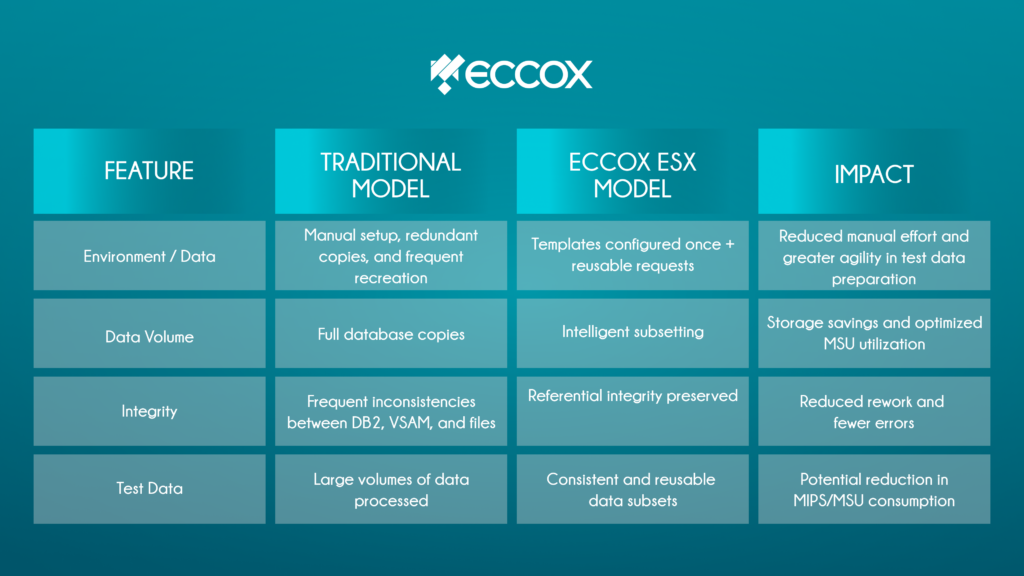
- Unnecessary full database copies
- Shared environments
- Inconsistencies between DB2, VSAM, and sequential files
- Provisioning queues
Meanwhile, teams wait—and waiting is expensive. Every idle hour represents not only delay, but resource consumption without generating business value.
Eccox ESX: Where ROI Actually Begins
Eccox’s approach is based on a simple principle: business acceleration is impossible if data cannot keep pace with code.
Eccox Application Environment Management for Data Setup (ESX) focuses on preparing and managing the data used during testing. Instead of relying on massive database copies, it uses intelligent data subsetting while preserving referential integrity across environments.
The impact is not incremental—it is structural.
A Six-Month ROI Is Not a Promise—It Is a Consequence
When the cost of the testing lifecycle decreases, three outcomes tend to occur simultaneously:
- Less rework and idle time
- Greater efficiency in managing and reusing test data
- Faster Time-to-Market
Together, these improvements change the financial equation. Investment shifts from being a prolonged CAPEX initiative to generating operational impact on OPEX much earlier.
Real-world implementations have demonstrated reductions of up to 87% in test environment provisioning time, along with significant productivity gains. More important than the percentage itself is the cumulative effect: every development cycle becomes less expensive than the one before.
Once data preparation is no longer a bottleneck, teams work with greater predictability, less rework, and faster delivery cycles. Depending on the architecture and operating model, these efficiencies can also contribute to optimizing infrastructure resource consumption, including MIPS/MSU.
One of the biggest misconceptions in modernization discussions is the belief that modernization alone automatically creates efficiency. It does not. If the operational model continues to consume resources inefficiently, the problem simply shifts elsewhere.
That is why the most effective mainframe modernization strategy does not begin with replacing technology. It begins by optimizing the processes that support the development lifecycle today.
Leadership’s Role: Changing the Starting Point
For CFOs and CTOs, the question is no longer whether to modernize, but how to capture value while modernization is still underway.
That requires a different approach:
- Move away from long projects with no intermediate returns
- Prioritize immediate operational gains
- Treat efficiency as a financial lever
Eccox operates precisely in this space, connecting mission-critical engineering with measurable business outcomes—not as a promise for the future, but as a practical way to reduce costs today while supporting sustainable growth tomorrow.
If your modernization ROI still depends on waiting until the end of the project, the problem may not be your strategy—it may be your starting point.
If your modernization strategy still requires waiting until the project is complete before delivering value, perhaps the issue is not the technology itself, but the operational model that supports it.