



Ending Data Isolation on z/OS
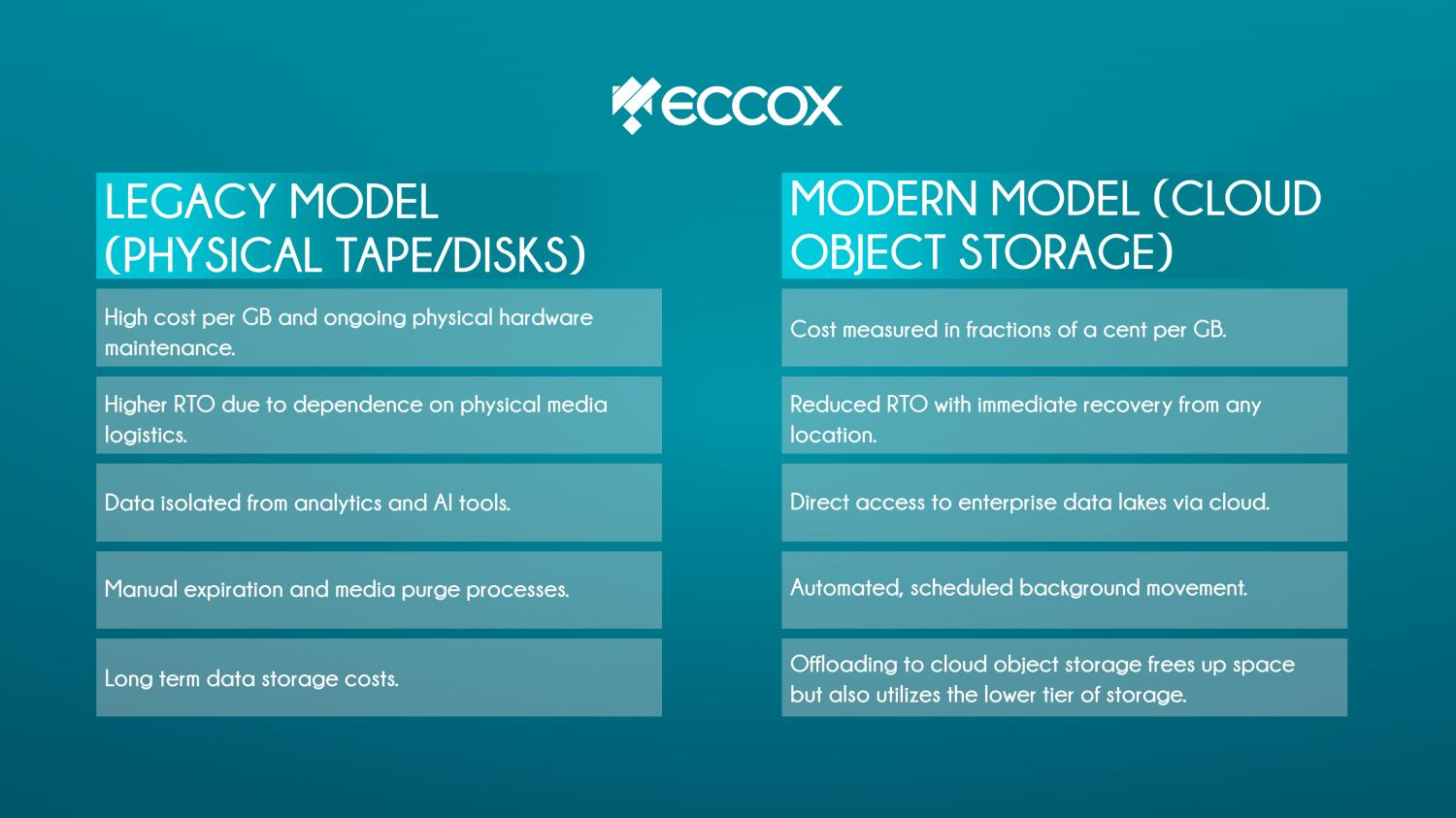
The mainframe remains the engine behind high-availability banking transactions. However, critical datasets kept on physical or virtual tape volumes and DASD that don’t connect with the rest of the enterprise create operational and financial bottlenecks.
This information isolation prevents the business from leveraging historical data for advanced analytics. For large Brazilian institutions, the transformation journey requires the mainframe to break free from the silo.
Eccox’s vision focuses on the platform’s long-term strategic value: modernizing does not mean abandoning z/OS—it means integrating it with modern storage to reduce costs and increase agility in accessing information.
The Roadblocks of Traditional Migrations
Legacy approaches to data movement—such as middleware or manual FTP processes—are inefficient and expensive. They add layers of risk and complexity that infrastructure teams can no longer sustain. Common pain points in large banks and Z Shops include:
- Excess hardware costs: Spending on x86 servers and intermediary storage used only as a bridge to the cloud.
- Transfer latency: Intermediate hops delay data availability for analytics applications.
- Budget pressure: Storage refresh cycles (disk and tape hardware renewals) drive major costs and demand transparency into what truly needs to remain on-prem.
- Maintenance complexity: Fragile transfer scripts and credential management across multiple platforms overload specialists.
The Solution: Native Integration with Cloud Storage
The native integration between z/OS and cloud storage — as enabled by solutions like STRATUS? — eliminates the need for intermediary hardware. Through our partners’ cloud integration solution, the mainframe consumes S3 APIs natively.
Data moves from z/OS straight into Cloud Object Storage (AWS, Azure, Google Cloud, or any S3 storage type) or on-prem as part of your hybrid cloud, avoiding vendor lock-in and maintaining data sovereignty.
Technical highlights of this approach
- Bi-directional data movement: The technology supports sending, retrieving, and converting data as the business requires (“send it, retrieve it, convert it”).
- Automated conversion: Integrated code page translation (EBCDIC to UTF-8) delivers data ready for consumption by modern applications.
- Deployment in hours: Installation is straightforward and does not require months-long network infrastructure projects.
- Accessible for new talent: Because it uses standard S3 patterns, professionals new to z/OS can operate it quickly, reducing dependency on niche expertise. No additional hardware or management server required.
- Schedule data transfers: Enables automated and recurring data transfers, ensuring operational efficiency without manual intervention.
- No additional hardware or management server required
Strategic Use Cases for Banking
Large public and private banks can use this technology to reduce storage TCO while maintaining resilience.
This technology is also essential for meeting security standards such as Sheltered Harbor. By moving backups to the cloud with immutability layers and logical isolation, institutions help ensure recovery data is protected against attacks and systemic failures at the primary site.
The ROI of Modernization: Real Cases and Strategic Value
Tangible results from large institutions confirm the sustainable value of this modernization:
Eccox Case with Banco Mercantil
1. Direct productivity gains and bottleneck elimination
- End of the 21-hour wait: Before Eccox, preparing a testing environment took an average of 21 hours. The solution enabled on-demand, instant test track creation—returning those hours to productive coding and business output.
- Faster delivery: Nearly 50% of users reported a noticeable 26% to 50% increase in delivery speed for new products and services.
2. Drastic reduction in rework (man-hour savings)
- 75% reduction in wasted time: The bank recorded over a 75% reduction in time previously spent fixing errors caused by environment conflicts.
- Broad impact: Nearly 85% of users (developers and QA teams) reported reduced rework, proving efficiency gains across the operation.
3. Infrastructure cost optimization (Mainframe/MIPS)
- Efficiency without new investments: Mainframe processing is historically expensive. Eccox’s solution enabled much smarter use of existing infrastructure.
- Reduced computational waste: By minimizing rework and code collisions in shared environments, the bank avoided unnecessary MIPS consumption—creating structural cost optimization and direct IT savings.
4. Business impact (Revenue generation and Time-to-Market)
- Faster product launches: Eliminating validation queues between technology and business teams enabled the bank to launch new credit policies and products faster, accelerating revenue generation ahead of competitors.
5. Risk mitigation and incident reduction
- Full isolation of test tracks (each with its own code and database): Enabled large-scale simultaneous testing without data corruption. This reduced incidents and increased system predictability, avoiding financial losses and reputational damage from core banking failures.
- Human capital optimization: With automation and increased autonomy (over 150 professionals trained in the new model), teams shifted from operational bottlenecks to higher-value activities, optimizing IT labor costs.
ROI Summary: The investment in Eccox’s solution paid off by enabling Banco Mercantil to do more (large-scale parallel testing), faster (up to 50% speed gains), with the same infrastructure (no new mainframe investments), and with far fewer errors (75% reduction in rework).
The Modern Mainframe as a Long-Term Asset
Mainframe modernization in 2026 is a strategic imperative for agility and security. The mainframe must be treated as a long-term asset—capable of sustaining continuous innovation without sacrificing the resilience required for mission-critical transactions.
Eccox Technology positions itself as a key strategic partner, offering an end-to-end consultative approach.
Modernization strategies developed in São Paulo (Brazil) are now exportedworldwide, proving that Brazilian banking engineering is a global benchmark for technical efficiency.
For IT leaders, the focus must be on eliminating chronic operational inefficiencies to enable long-term business sustainability.