



The role of the mainframe in digital resilience: security, compliance, and control of critical data
For a long time, the dominant security strategy was to protect the infrastructure perimeter. Firewalls, segmented networks, access control. External layers trying to protect something that, at its core, remains vulnerable within its own architecture.
That model no longer holds.
The attack surface has expanded, flows have become distributed, and regulation no longer accepts reactive responses. Today, digital resilience is not just about reacting to incidents — it is about structurally reducing exposure to risk.
At this point, the mainframe has never stopped being relevant. It has simply been misunderstood. Resilience is not where you protect. It is where you process.
Because in critical environments, risk rarely originates in infrastructure. It emerges from inconsistencies that accumulate throughout operations:
- Data replicated without governance
- Parallel environments without control
- Exposed testing flows
- Business logic no one has revisited
The reality is simple: the more data moves, the greater the risk. And data doesn’t move only in production — it flows through testing, staging, pipelines, and integrations.
It is along this path that most security strategies lose visibility, focusing protection at system entry points while operations remain exposed.
DORA, PCI 4.0, GDPR, LGPD: what has actually changed
Regulation is no longer about periodic audits. It has become a continuous requirement for traceability, control, and predictability.
- DORA requires measurable operational resilience
- PCI DSS 4.0 demands strict control over the payment data lifecycle
- GDPR / LGPD require governance over data usage, access, and exposure
- Basel III directly links operational risk to financial health
The point is straightforward: it is not enough to protect data — you need to know where it is, where it flows, and in what condition it exists.
A recurring mistake is protecting the core and ignoring everything around it. The mainframe solves part of this challenge through inherent architectural characteristics: logical isolation, native encryption, access control, and transactional consistency. But there is a blind spot that is rarely discussed: everything that happens outside production.
This is where you find:
- Uncontrolled database copies
- Sensitive data in test environments
- Inconsistencies across environments
- Failures that only surface in production
In other words, risk is not only about external attacks — it is embedded in how the entire environment operates.
Mainframe modernization as a security strategy
There is a common misconception that modernization increases exposure. In practice, the opposite happens. When modernization is done with control, it:
- Reduces invisible surfaces
- Eliminates manual processes
- Increases traceability
- Standardizes flows
Mainframe modernization is not just technological evolution. It is a continuous reduction of operational risk.
The critical point is that data must follow governance. There is no compliance without data control — and there is no control when:
- Each environment holds a different version
- Referential integrity is lost
- Sensitive data is replicated without criteria
- Restoration depends on manual effort
In this scenario, every audit becomes uncertainty, and every incident becomes a surprise.
Eccox ESX: security applied to the full data lifecycle
Experience in mission-critical environments shows that security is not solved at the core alone. It must exist across the entire lifecycle.
Eccox ESX (Application Environment Management for Data Setup) operates exactly where most strategies fail: managing and controlling data outside production.
In practice:
- Automated creation of consistent environments
- Controlled cloning of DB2, VSAM, and file-based data
- Preservation of referential integrity
- Reduction and anonymization of sensitive data (GDPR / LGPD)
- Fast, auditable restoration through baseline
The impact is not only operational — it is regulatory. Because it enables precise answers to questions such as:
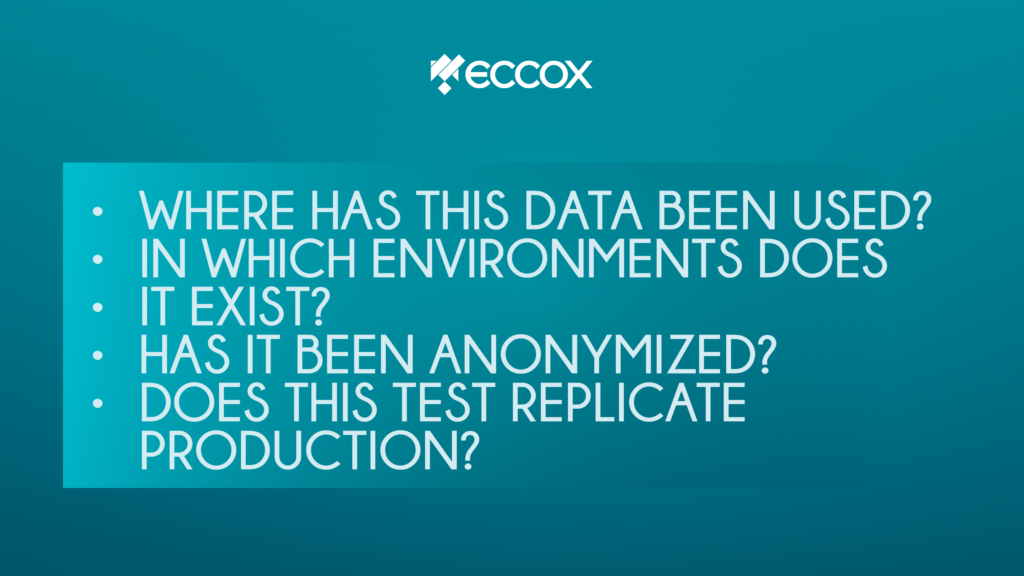
Without this level of control, compliance becomes effort. With it, it becomes structure.
Performance is also security
One of the least explored dimensions of security is performance. Overloaded environments delay validations, increase inconsistency windows, and expand exposure to failure.
In the context of real-time payments, this becomes critical. If the environment cannot respond in milliseconds, the risk stops being technical and becomes financial.
At the same time, the modernization debate often misses a key point: the value is not in replacement — it is in control.
The mainframe remains the most reliable environment for critical data because it:
- Centralizes governance
- Reduces fragmentation
- Maintains consistency
- Enables real auditability
When integrated with modern practices, it stops being perceived as legacy and becomes the foundation of operational trust.
Digital resilience is not an additional layer — it is an architectural characteristic. Organizations that treat security only as external protection remain exposed.
Those that understand the full lifecycle — code, data, environment, and operations — build predictability, that in critical environments, isn’t a luxury. It is what sustains compliance, reputation, and results.
Mainframe modernization, when driven by governance and data control, stops being a technical initiative and becomes a strategic risk decision.
If your security strategy still does not consider the full data lifecycle, the risk is not only in what you protect — but in what you cannot see.